


You Can’t Win Without Great Goaltending… Until You Can
By: Rob Pizzola, CEO of The Hammer Betting Network
A note before you read
Writing is not my thing. I find it time intensive and honestly not something I enjoy. So I use AI to help me put these articles together. The ideas, the methodology, the data pulls, and the analytical framework are entirely my own. My typical process is to work through the analysis, record voice notes explaining what I want to convey, and then use AI to shape those into a readable piece. I go over everything afterward to make sure the substance is accurate and up to my standard. I think being upfront about that process is important.
Every spring the same phrase gets recycled in hockey circles across North America. You hear it so often that it stops sounding like a claim and starts sounding like a fact. You can’t win the Stanley Cup without great goaltending. The problem is not with the statement itself. The problem is with how it gets used when people are trying to pick playoff winners and price playoff series.
When analysts invoke goaltending as a predictive tool, they are almost always pointing at what a goalie did during the regular season. What nine full years of playoff data shows is that this connection is essentially imaginary. Regular season goaltending performance has almost no predictive relationship with how far a team advances in the playoffs, and betting as though it does is a consistent way to land on the wrong side of the market. (You may be wondering why I chose nine full years as it might seem like an arbitrary number. I have tested all sorts of time periods and the underlying analysis does not change significantly. I think going back further than a decade could be problematic as we would be running analysis on a game that was substantially different than the game that is played today.)
The metric worth understanding here is Goals Saved Above Expected, or GSAx. This is not the same thing as Goals Saved Above Average, or GSAA. GSAx measures how a goalie performs relative to what an expected goals model predicts given the actual quality of the shots he faces. Every shot gets assigned a probability of going in based on its location, type, and distance. GSAx measures how many fewer goals a goalie allowed than that model would have predicted. A high GSAx means a goalie is personally outperforming shot quality expectations. The correlation between a goalie’s GSAx and his team’s possession metrics in this dataset is essentially zero, which means elite numbers show up freely on both strong and weak teams.
The question that matters for betting is whether a goalie who outperformed shot quality models during the regular season can be expected to keep outperforming them in the playoffs. Nine years and 144 goalie seasons give a clear answer. The correlation between regular season GSAx and playoff round reached is negative 0.089, with a p-value of 0.29. That does not come close to statistical significance. If you don’t have a stats background or this goes over your head for any reason, the TLDR is this: The team with the better regular season GSAx goalie wins a first-round series 49 percent of the time. That is a coin flip.
My view on why this happens comes down to a few things. First, there is straightforward mean reversion. Extreme outperformance in any environment that mixes skill and randomness tends to pull back toward average in subsequent periods. A goalie posting a GSAx dramatically above his historical baseline is almost certainly getting some contribution from variance, shots finding him in favorable spots, bounces going the right way. That variance does not carry forward. Among playoff goalies in this dataset, those who posted a GSAx above 15 in a given season dropped by an average of 15.3 the following year.
Second, the playoff environment is fundamentally different. Shot selection becomes more deliberate, opposition quality jumps across the board, and every team has spent days (or even weeks) preparing specifically for each goalie they will face. The expected goals bar gets raised just as the goalie is most likely to regress toward it.
Third, and this one is underappreciated, goaltending variance across a seven-game series is enormous. A goalie can face 200 shots in a series and the randomness in how those shots bounce off posts, pads, and crossbars can completely override whatever the underlying numbers say about him. Eight of the nine highest regular season GSAx performances in nine years of data were followed by playoff runs where the goalie ran cold or barely broke even against expected goals.
The sharpest evidence comes from tracking the goalies who posted the highest regular season GSAx numbers and watching what happened once the playoffs started.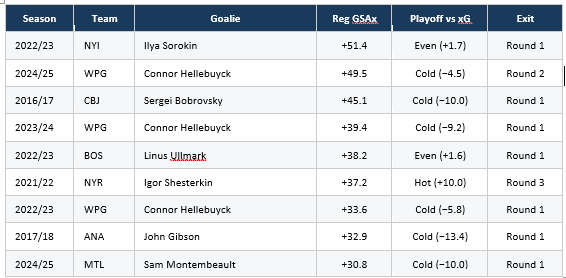
Ilya Sorokin posted plus 51.4 GSAx for the Islanders in 2022/23, the highest single season mark in the entire dataset. He ran essentially even against expected goals in the playoffs and New York lost in the first round. Sergei Bobrovsky posted plus 45.1 for Columbus in 2016/17 and his team ran cold. Linus Ullmark posted plus 38.2 for Boston in 2022/23 and was bounced in the first round. Connor Hellebuyck has appeared on this list three separate times and his teams ran cold against expected goals in every single one.
But here is the question Alex Moretto raised when reviewing a draft of this piece, and it is a fair one. We have shown that elite regular season goaltending does not predict playoff success. But does the opposite hold? Are teams with weak regular season goalies at a systematic disadvantage?
The answer is also no, and in some ways the data on this side is even more interesting.
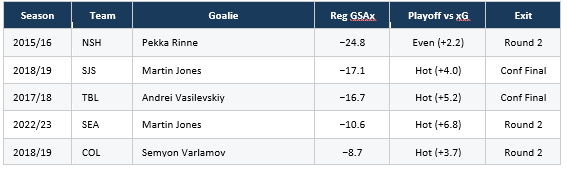
Goalies who ranked in the bottom third by regular season GSAx advanced past the first round 49 percent of the time. Goalies in the top third advanced past the first round 51 percent of the time. Those numbers are not statistically different from each other. The bottom-third goalies also ran slightly hotter on average against expected goals in the playoffs, posting a positive luck differential of plus 1.5 compared to minus 0.7 for the top third group.
Pekka Rinne posted a GSAx of minus 24.8 for Nashville in 2015/16, the worst mark in the entire dataset, and his team advanced to the second round. Andrei Vasilevskiy posted minus 16.7 for Tampa Bay in 2017/18 and reached the conference finals. Martin Jones posted minus 17.1 for San Jose in 2018/19 and also reached the conference finals. The team with the worst regular season goaltending in this entire nine year dataset (both goalies combined) was a conference finalist. There is simply no systematic penalty for coming into the playoffs with a goalie who struggled during the regular season, just as there is no reliable reward for coming in with one who excelled.
The implication is symmetrical and important for betting. Do not pay a premium for teams with elite regular season goalies. But also do not fade teams simply because their goalie has been below average. The regular season number is close to noise in both directions once the playoffs begin.
The Cup winners over this same period make the same point, and two of the most instructive cases involve goalies who were not even the anticipated starter heading into the postseason.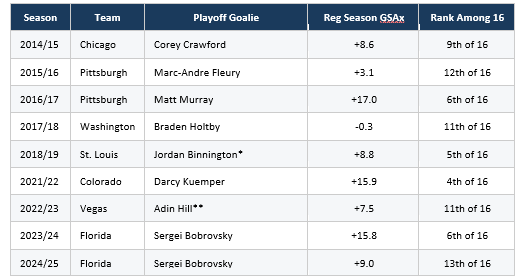
*Binnington was called up in January 2019 with only 32 regular season games before becoming the playoff starter. ** Logan Thompson started the regular season for Vegas but was injured prior to the 2022/23 playoffs. Adin Hill and Laurent Brossoit carried the playoff workload.
Jordan Binnington came up in January 2019 with St. Louis on the verge of a historic collapse. He played 32 regular season games, posted a respectable but unspectacular GSAx of plus 8.8, and then got hot at exactly the right time and carried his team to a Stanley Cup. Nobody predicted it because there was essentially no basis to predict it. Vegas in 2022/23 takes the unpredictability argument even further. Logan Thompson was the regular season starter before he was injured. Adin Hill stepped in and was outstanding. Two backup goalies nobody was building a betting case around ended up central to why that team won the Cup.
With that full picture in place, here are the updated regular season goaltending numbers for the 2026 playoff field. Worth noting that this year has an unusually murky set of starter situations, which itself reinforces the central argument.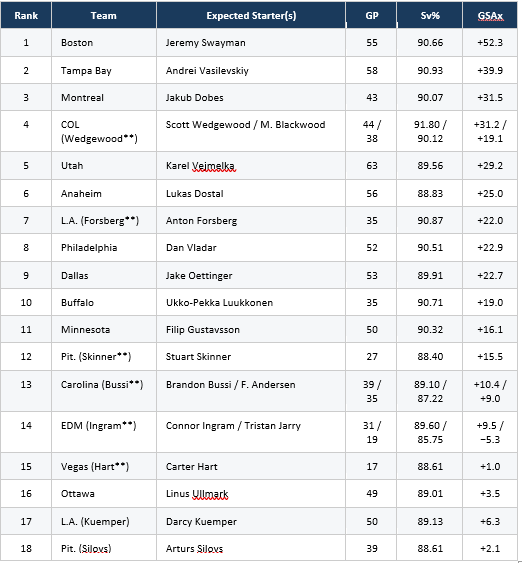
** Uncertain starter situation. Wedgewood and Blackwood are close to 50/50 in Colorado. Hart expected to start for Vegas. Forsberg has outperformed Kuemper significantly and could start for LA. Ingram is the likely Game 1 starter for Edmonton. Bussi and Andersen are close to 50/50 in Carolina. Skinner and Silovs splitting time in Pittsburgh.
Jeremy Swayman has posted a GSAx of plus 52.3, the highest single season mark in the nine year dataset. It is a remarkable number and it may inflate Boston in series betting. Their underlying shot quality metrics against playoff caliber opponents rank among the weakest in the bracket, meaning the Bruins have been heavily dependent on this level of outperformance all season. That is precisely the situation the data says is most likely to reverse. The goalie who ends up being the story of these playoffs is probably not the one sitting at the top of the rankings right now.
The practical takeaway is straightforward. Do not pay a premium for regular season goaltending in either direction. Do not fade teams with modest GSAx numbers. The regular season number tells you how much a goalie outperformed shot quality models over roughly 50 games. It does not tell you what he is going to do in a seven-game series, and this year in particular it may not even tell you who is going to be playing. What does predict playoff advancement with far more consistency is the quality of shots a team generates and allows at even strength, particularly against other playoff caliber teams. Build your framework around that.
The conventional wisdom says you need great goaltending to win the Stanley Cup. Nine years of data make clear that you almost never see it coming.
Rob Pizzola is the CEO of The Hammer Betting Network and a professional sports bettor. All statistical data sourced from Evolving Hockey. GSAx measures goals saved above expected, adjusting for the shot quality a goalie faced. Analysis covers all 144 playoff team seasons from 2014/15 through 2024/25.
________________________________________

Check out Kalshi and get signed up today: https://kalshi.onelink.me/1r91/hammer

New to FanDuel Sportsbook? Bet $5 and Get $300 in Bonus Bets if your bet wins. Download the FanDuel Sportsbook App or check it out at http://fanduel.com/forwardprogress to get in on the action. |
Must be 21+ and present in select states or 18+ and present in DC. Opt in req. Bonus issued as non-withdrawable profit boost tokens. Restrictions apply, including any token expiration and max wager amount. See terms at sportsbook.fanduel.com. Gambling Problem? Call 1-800-GAMBLER or visit rg-help.com. |

Join our Discord and be a part of the Conversation. Access to Creators and more: JOIN DISCORD
PredictionData.io
Building in prediction markets? Stop duct-taping data together. Ship faster with one unified API for sportsbook and prediction market data. See the API.

Every bettor talks themselves into picks. FTN helps you talk yourself out of bad ones. The platform gives you unbiased team and player context so you are not chasing last week or falling for hype. Start with Stats Pro or upgrade to Stats GOAT. Use HAMMER10 for 10% off. Head over to FTNFantasy.com